
This title is inspired by the Peanuts comics, which was comically shared with me in response to my Lemonade Stand Story. For those who know the story, feel free to skip this part. But for those who don’t—lean in.
The Lemonade Stand Story
Our daughter got a bee in her bonnet and wanted to make her own lemonade stand. After lots of trial and error, many more meltdowns than were strictly rational, and a little help from her dad, she finally had her cardboard stand all ready. She squeezed the lemons, made the lemonade, and went to bed excited about sharing it the next day.
To my horror, I woke up the next morning to find her all dressed and ready to hand out lemonade to strangers on the street—not just to her immediate family as I had assumed. (I had seriously underestimated her ambition!) With a little evangelism in the making, we obliged—but convinced her that noon would be a better time for lemonade than 8:45 a.m.
Knowing how eager the French are to avoid social interaction, Andrew warned her that people might be suspicious of something being handed out for free. So we concluded the park would be a better spot to set up—full of children and (supposedly) friendly families—hoping, maybe, just maybe, our daughter wouldn’t have to face the terrible sting of rejection.
Two hours later, my kids and I arrived at the park, which was packed with kids, mums, and nannies. Our daughter—already embarrassed about walking across the city carrying her stand—started getting cold feet and said she wanted to go home. But I convinced (a.k.a. forced) her to stand her ground. I also wanted to go home because I hate approaching strangers, but I had to model courage for my kids.
Everyone clearly saw us arrive. We set up the stand, and after some coaxing to keep my daughter from bolting, I mustered all the courage I had and shouted: “WHO WANTS FREE LEMONADE?!”
A boy ran past saying “no thanks,” two mums looked on with amusement, and the rest just ignored us.
No one came for free lemonade.
We hung around awkwardly for a while. I explained the story to the two mums who responded with, “Aw, cute,” smiled—and walked away. My kids had some lemonade, and when my two-year-old started crying because he wanted more, we packed up and left the park.
Our daughter was now really embarrassed and just wanted to go home—and so did I. But I was determined this mission was not going to fail. I even considered going up to a group and quietly asking them to take lemonade from us for the sake of my child’s dignity.
We decided (and by “we,” I mean I decided) to set up again in the big open area next to the park that gets plenty of foot traffic. Just as my nervous system was about to give out, a large class of Spanish teenagers and their teachers walked by and approached us, intrigued. They were on a school trip from across the border and found our kids super cute. We handed out all the lemonade (I didn’t want to take any home at that point), chatted with them a bit, they asked to take a photo with us, and I pointed out some good sightseeing spots.
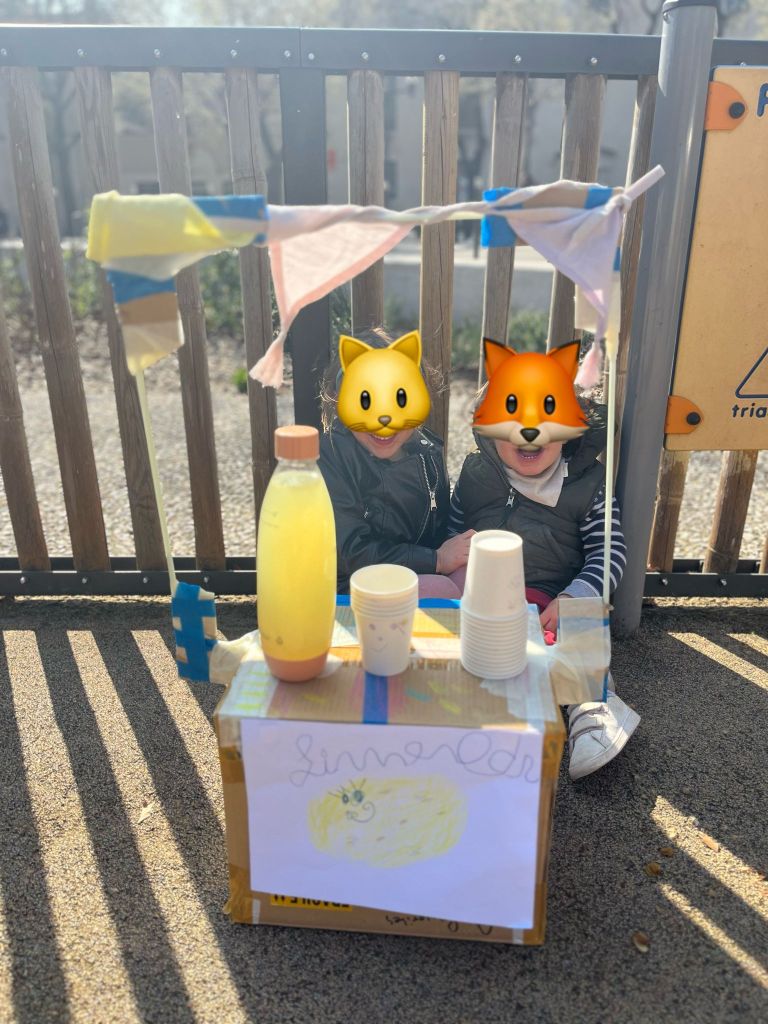
Mission accomplished.
Phew. My nerves were shredded. My heart was proud and broken at the same time. I would never have had that kind of initiative and courage at her age—probably because I grew up in this culture. But there she was, as determined as ever, facing rejection and coldness head-on.
A Culture of Shame
What made the outing especially hard for me wasn’t just how unfriendly the park crowd was. It brought up everything I felt as a child: shyness, shame, fear of standing out. I remember being eight or ten and too shy to ask a waiter for the bill. Years later, I was in awe of how confident South African children were.
When I was recovering from my quarter-life crisis (a.k.a. COVID-19 PPD faith-crisis cocktail), I read Brené Brown’s Daring Greatly. I learned that much of the deep, persistent shame I carried into adulthood stemmed from growing up in a shame-based culture. The French and Franco-Swiss culture is one where creativity is stifled, small mistakes are character flaws, and if you don’t fit the mold, you’re excluded. Above all, shame stifles genuine human connection.
No wonder I begged my parents to send me to an international school—and when that didn’t help, to a British boarding school—and when that didn’t help, to South Africa! I ran away. But fortunately, in doing so, I ran right into God.
Of course, there are aspects of this culture I admire. I uphold Swiss excellence. I respect the French commitment to rest. I love that I’m no longer the only one who makes a big deal of celebrating. But friendliness? Not a national strength.
After this appalling experience, I was left with a feeling I’ve been wrestling with the last couple of weeks: loneliness. Right now, we’re really missing our life in Cape Town—our home, our friends, our maid (cleaning your own house is exhausting! #literalfirstworldproblem). We miss how easy it was to strike up a conversation with a stranger. If we’d done this in a South African park, we’d have had five new friends and no lemonade left within minutes. (Cue Mike Little joke: “That’s because it would’ve been stolen!”)
We feel a bit like Jonahs, responding to God’s call by saying, “Those are bad people doing bad things! They don’t deserve it!” (At least that’s what he says in the Storybook Children’s Bible.) It’s tempting to give up and go back—especially when I think about the life our kids could have. But then, we’d be running away.
The Next Generation
It’s hard to have compassion for hard-hearted people. I pray that my heart would break for the adults of this nation. But right now, it breaks for the children.
I’ve always had children close to my heart—even in South Africa. Around the world, kids suffer so much at the hands of adults and the cultures they live in. And here, I grieve for the children growing up in shame—including my own daughter, who has to endure an old-fashioned, rigid, backward school system. (No offense to the many wonderful French teachers just doing their best in a flawed system.)
This reminds me that God sent us here for the next generation. That’s not to exclude the adults—but my focus is on discipling the young. Which brings me to a prayer request.
The leaders of the children’s ministry are organizing a yearly weekend away for the kids. I’m helping plan and lead this year, and I’m excited. The theme is: “Hearing God’s Voice.” Through stories, games, and activities, we’ll teach the importance of recognizing the Father’s voice and the practice of listening to the Holy Spirit. I’ll be leading a prophetic workshop for the children, and I’d love your prayers.
There will be about a dozen children, ages 4–12, including our daughter. I’m expectant that the Holy Spirit will show up and touch their hearts and lives.
I suspect it takes years to earn the trust of French people—but once it’s earned, the loyalty runs deep. Many stay close to the friends they made as children and teens. So maybe the best chance we have at reaching this nation is by discipling French children. If they can experience the love of Christ through us—or better yet, directly through an encounter with the Father—they’ll be the ones who carry that love into their own culture and lead change from the inside out.
 Alive In France
Leave a comment