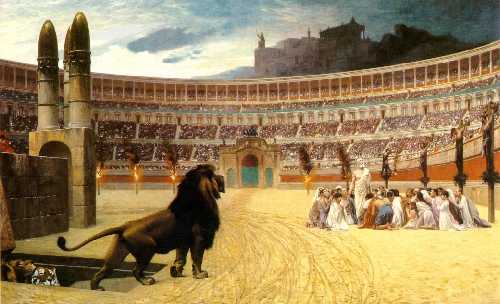
Most of Europe pre- 2nd Century was made of Celtic cultures and religions. The Gaulois, who had fought nail and tooth against oppression, were eventually submitted under Roman Law (think Asterix and Obelix with less victories and more people being hitched off to be slaves and gladiators). Until then, the small rural agrarian societies of Gaul (France) had been led by local Druids who played roles as religious leaders, law-enforcers, medical professionals, and political governors. Not much is known of them because their beliefs forbade them to keep written accounts but in some medieval tales, they are likened to sorcerers (Eish…seems that witchcraft is not limited to Africa). The term druid surfaces in a poem penned by Blathmac around the 8th century, where Jesus is described as “better than a prophet, more knowledgeable than every druid, a king who was a bishop and a complete sage.”
The good news had made its way to the region sure but, as it was often the case, it was received with strong opposition… to say the least.
I’ve been told that Irenaeus, known for speaking up against Gnosticism, is the first (famous) martyr of France… but a bit of digging tells a different story (nerd alert!) Irenaeus was the second bishop (what evangelicals these days would call an apostle) of Lugudunum (Lyon) and all of Gaul. His predecessor, St Pothinus, was in fact martyred during the Persecution in Lyon around AD 177 along with 48 others, including a slave girl, Blandina, who bore the most horrendous death. Why she wasn’t made a saint…I don’t know!
The first bishop of Lutetia (Paris), St Denis, was also martyred with his companions on the hill of Montmartre (Mount of Martyrs) which funnily enough had been a hot spot for druid worship. Montmartre to this day one of my favourite places in Europe and I hope to write about it in future!
So, for the most part, the Gaulois continued to worship their Celtic gods – albeit sometimes with a Roman twist, and Christianity was not very popular. Then, in AD 312 something unbelievable happened. Constantine, who was battling family members to be sole emperor of the Roman Empire, had a vision. It is said that the night before a significant battle, he and his solders saw a burning cross in the sky and the Greek words saying: “In this sign conquer.” He had a subsequent dream of Jesus in bright white clothes, holding a cross, saying to Constantine that he would win against his enemies if he made the cross his symbol. So he marked his solders’ shields with the cross and had a banner made with Christ’s initials on it. When they won the Battle of Milvian Bridge, he accredited the victory to the Christian God and in the following year issued the Edict of Milan which allowed Christians to practice freely. Christendom is often accredited to him but (nerd alert again!), though he massively influenced the growth of Christianity throughout the Roman Empire, it wasn’t until the emperor Theodosius issued the Edict of Thessalonica in AD 380 that Christianity was made the official state religion. And it all went downhill from then…
Jokes, I don’t know. I’m not a fan of Christendom, but I guess we’ll see what happens next in the following blog: A (not-so-brief) history of Christianity in France Part II: The Middle Ages (comming soon)
References
Mac Mathúna, Liam (1999). “Irish Perceptions of the Cosmos” (PDF). Celtica. 23: 174–187, esp. 181.
Wikipedia – Persecution in Lyon
 Alive In France
Leave a comment